sbc-emu runs each board’s own operating system, unmodified, on CPU cores and SoC models written from scratch in Rust. All seven boot right here, compiled to WebAssembly and running on your computer, not on a server.
Each board is modelled down to the registers its Linux drivers touch: interrupt controller, timers, storage, display, USB, network and, on most of them, the GPU. The goal everywhere is the stock image, booted unmodified.
Raspberry Pi 4 Model B
Boots in your browser
SoC
Broadcom BCM2711
CPU
4 × Cortex-A72
Instruction set
64-bit Arm
GPU
V3D 4.2: GLES 3.1, Vulkan 1.3
The furthest along. Unmodified Raspberry Pi OS, and Ubuntu 26.04 Desktop with GNOME on Wayland drawn by Mesa on the emulated GPU. HDMI, USB, Ethernet, Wi-Fi, Bluetooth, audio, GPIO, I²C and SPI all run on their stock drivers.
Power on
The Pi’s own kernel and a BusyBox shell on its HDMI screen, resumed from a 15 MB snapshot.
3D demos
Raspberry Pi OS running kmscube and glmark2 on the emulated GPU, from a 63 MB snapshot.
Your own SD card
Drop an Ubuntu Server or Raspberry Pi OS image, as downloaded, and boot it. Nothing is uploaded.
Orange Pi One
Boots in your browser
SoC
Allwinner H3
CPU
4 × Cortex-A7
Instruction set
32-bit Arm, Thumb-2
GPU
Mali-400: kmscube on lima
The unmodified Armbian image to its login prompt, with the HDMI console, a USB keyboard and Ethernet. Its 32-bit core has its own JIT, to AArch64 and x86-64 natively and to WebAssembly in the browser.
Power on
Alpine’s kernel boots from scratch to a serial shell in under ten seconds. A 15 MB download.
Orange Pi RV
Boots in your browser
SoC
StarFive JH7110
CPU
4 × SiFive U74
Instruction set
64-bit RISC-V
GPU
PowerVR BXE-4-32: Vulkan, vkcube
The board’s whole boot chain from its SPI flash or the SD card: boot ROM, U-Boot SPL with DDR init, OpenSBI and U-Boot, then Alpine’s mainline kernel, Xunlong’s own, or Canonical’s Ubuntu 24.04.5 server image, unmodified. Wi-Fi, Bluetooth, USB 3.0, an NVMe SSD and HDMI.
Power on
OpenSBI and Alpine’s mainline kernel boot from scratch to a serial shell in about five seconds. A 17 MB download.
ASUS Tinker Board S
Boots in your browser
SoC
Rockchip RK3288
CPU
4 × Cortex-A12
Instruction set
32-bit Arm, Thumb-2
GPU
Mali-T760: Panfrost
The unmodified Armbian image from the SD card or eMMC to a login on its HDMI screen, with the RK808 power controller and real-time clock. Mesa’s Panfrost driver renders kmscube and all 25 scenes of the GLES 2 test suite, matching software rendering.
Power on
Debian’s kernel and the board’s own device tree boot from scratch to a serial shell in under ten seconds. An 11 MB download.
Orange Pi 5
Boots in your browser
SoC
Rockchip RK3588S
CPU
4 × Cortex-A76, 4 × Cortex-A55
Instruction set
64-bit Arm
GPU
Mali-G610: first GLES frames
Eight cores, big and little, on GICv3. Armbian to its login prompt, with HDMI, USB 3.0, an NVMe SSD in the M.2 slot, Ethernet and audio. Mesa’s first GLES frames from the Mali-G610 reach its HDMI screen.
Power on
Debian’s kernel boots from scratch on four of the cores to a serial shell in under ten seconds. A 20 MB download.
Jetson Nano
Boots in your browser
SoC
NVIDIA Tegra X1
CPU
4 × Cortex-A57
Instruction set
64-bit Arm
GPU
Maxwell: GLES 3.2
Debian 13 from the microSD card, with Debian’s own kernel and open drivers: Ethernet, USB, HDMI, and the Maxwell GPU through nouveau and Mesa, with compute, geometry and tessellation shaders.
Power onGPU demos
Debian’s kernel boots from scratch to shells on the serial console and HDMI in about 15 seconds: a 23 MB download. The GPU demos (33 MB) draw on the HDMI monitor with Mesa.
ESP32-S31 Function CoreBoard
Boots in your browser
SoC
Espressif ESP32-S31
CPU
2 × RV32IMAC
Instruction set
32-bit RISC-V
GPU
None
A microcontroller that runs Linux. Espressif’s official flash image, unmodified, through the chip’s own mask ROM, U-Boot SPL, OpenSBI and U-Boot, to Linux 6.18 executing in place from flash, on both harts.
Power on
The official flash image boots through the ROM, U-Boot and OpenSBI to a root shell in about 10 seconds. A 10 MB download.
Four CPU cores, written from scratch
The boards share their cores, the snapshot format, the virtual network and this site. A new board is mostly its SoC: the devices between the CPU and the connectors.
64-bit Arm
arm-a64
Raspberry Pi 4, Orange Pi 5, Jetson Nano. ARMv8-A with FP and NEON, exact to Arm’s rounding and NaN rules. A block JIT to AArch64 and x86-64 natively, and to WebAssembly in the browser.
32-bit Arm
arm-a32
Orange Pi One, Tinker Board S, and 32-bit programs on the Pi 4. A32, Thumb-2, VFPv4 and NEON, with JITs to AArch64, x86-64 and WebAssembly.
64-bit RISC-V
riscv64
Orange Pi RV. RV64GC with the U74’s bit-manipulation extensions and Sv39 paging, under real OpenSBI. A block JIT to AArch64 and x86-64 natively, and to WebAssembly in the browser.
32-bit RISC-V
riscv-rv32
ESP32-S31. RV32IMAC with machine, supervisor and user modes and Sv32 paging, from the esp32sim project. A block JIT to AArch64 and x86-64 natively, and to WebAssembly in the browser.
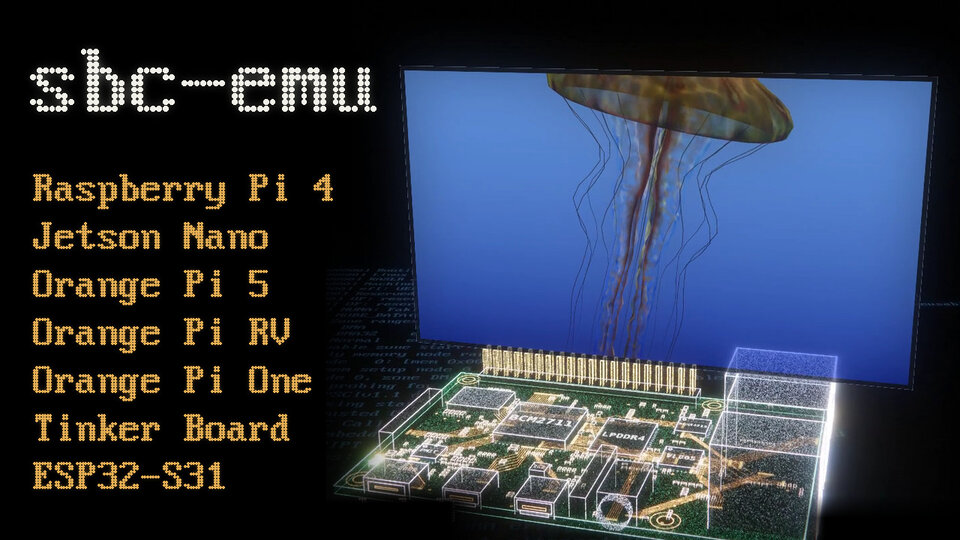 The 0.1.0 announcement film, 70 seconds, on YouTube